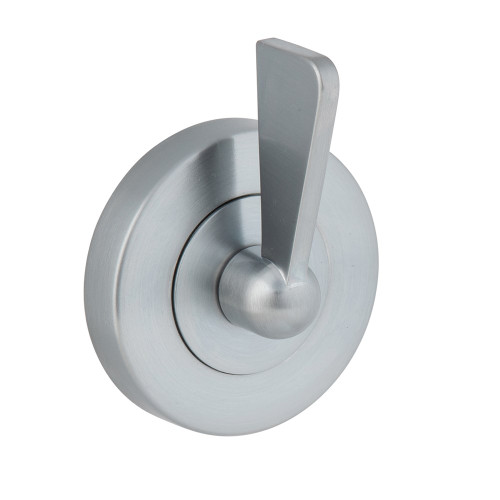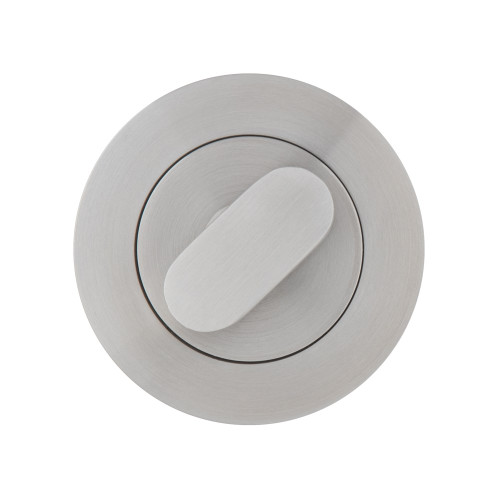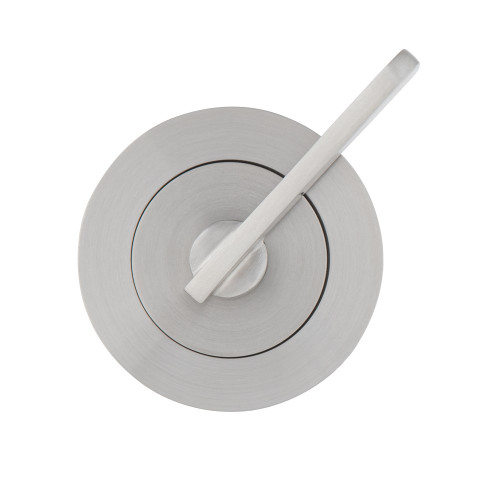

Dormakaba Disabled Turn Snib 4310 - Satin Stainless Steel
 Key Features
- Disabled turn snib designed for accessible bathroom and toilet doors.
- Concealed fixing for a clean, tamper resistant appearance.
- Screw-on cover conceals mounting screws after installation.
- Manufactured from 316 grade stainless steel.
- Part of the Dormakaba Coastal hardware range.
 Specifications
- Item Code: DK4310SSS
- Product Type: Disabled turn snib
- Rose Diameter: 53 mm
- Rose Thickness: 10 mm
- Material: Stainless steel
- Stainless Steel Grade: 316
- Fixing Type: Concealed
- Finish: Satin Stainless Steel
 What's In The Box
- 1 x Dormakaba disabled turn snib on round rose
- Fixing screws
 Suitable Uses
- Accessible bathroom and toilet doors.
- Commercial buildings requiring disabled compliant hardware.
- Coastal or corrosive environments where 316 stainless steel is preferred.
Dimensions
 Frequently Asked Questions
- Is this suitable for disabled toilet doors?
Yes, it is designed for accessible toilet and bathroom applications when used with a suitable privacy or indicator lock. - Are the fixing screws visible after installation?
No, the unit uses concealed fixings with a screw-on cover for a clean appearance. - Can this be used outdoors?
Yes, the 316 grade stainless steel construction makes it suitable for external and coastal environments.
 Additional Information
- Disabled turn snibs are commonly paired with indicator or privacy bolts on accessible toilet doors.
- 316 grade stainless steel is typically specified in coastal Australian projects to reduce corrosion issues.
- Correct installation height and clearances should be checked against accessibility standards for compliance.
dormakaba Warranty
dormakaba Australia Pty Ltd (ABN 14 067 969 466) provides the following warranty on all dormakaba branded products sold in Australia. This warranty is in addition to, and does not limit, your rights under the Australian Consumer Law.
 Warranty Summary
 How to Make a Claim
For full returns and warranty claim procedures, visit our Returns & Warranty page - this is kept up to date and is the authoritative reference for current claim steps.
- Report the defect promptly. Contact Terry's Tradies Pty Ltd and its associated websites, trading names, and subsidiaries (including Gold Coast Smart Locks) as your point of sale in the first instance. Claims must be lodged no later than 1 month from the date the defect becomes obvious.
- Prepare your documentation. You will need proof of purchase (invoice or receipt), the date of delivery or installation, your name and address, and any maintenance records relevant to the product.
- Make the product available for inspection. dormakaba requires adequate access to the goods, fittings, and fixtures to assess any warranty claim and carry out repairs. If no fault is found, dormakaba's standard costs for inspection, service, and testing apply.
- Warranty work is conducted during normal business hours - 8:00am to 5:00pm, Monday to Friday.
Note: The expense of making a warranty claim (including transport and access costs) is borne by the purchaser.
 Exclusions
This warranty does not cover:
- Damage or defects caused by misuse, abuse, neglect, or failure to follow dormakaba's selection, installation, and maintenance instructions
- Fair wear and tear
- Damage arising from installation not carried out by dormakaba or its authorised agents
- Damage caused to the structures the product is installed in, where installation was not by dormakaba or its authorised agents
- Damage caused by circumstances beyond dormakaba's control
- Defects within acceptable industry variances
- Products used other than for their intended purpose
- Damage from exposure to abnormal conditions, including but not limited to extreme temperature, water, fire, humidity, pressure, or stress
- Products that have been modified, built on, or repaired by a third party
- Products not maintained in accordance with dormakaba's care, cleaning, and maintenance instructions (as amended from time to time on the dormakaba website)
- Routine maintenance items (the purchaser's responsibility)
- Products installed, maintained, or operated other than in accordance with dormakaba's instructions
- Overhaul, replacement, or repair work carried out prior to dormakaba's approval of a warranty claim
 Important Notes
Australian Consumer Law
In Australia, our goods come with guarantees that cannot be excluded under the Australian Consumer Law. You are entitled to a replacement or refund for a major failure, and compensation for any other reasonably foreseeable loss or damage. You are also entitled to have goods repaired or replaced if they fail to be of acceptable quality and the failure does not amount to a major failure. Nothing in this warranty limits or excludes these statutory rights.
In Australia, our goods come with guarantees that cannot be excluded under the Australian Consumer Law. You are entitled to a replacement or refund for a major failure, and compensation for any other reasonably foreseeable loss or damage. You are also entitled to have goods repaired or replaced if they fail to be of acceptable quality and the failure does not amount to a major failure. Nothing in this warranty limits or excludes these statutory rights.
Replacement & Repair
dormakaba reserves the right to replace defective parts with components of similar quality, grade, and composition where an identical part is unavailable. Refurbished parts or goods of the same type may be used. For discontinued or unavailable products, dormakaba may substitute an equivalent current product. All products replaced under warranty become the property of dormakaba.
dormakaba reserves the right to replace defective parts with components of similar quality, grade, and composition where an identical part is unavailable. Refurbished parts or goods of the same type may be used. For discontinued or unavailable products, dormakaba may substitute an equivalent current product. All products replaced under warranty become the property of dormakaba.