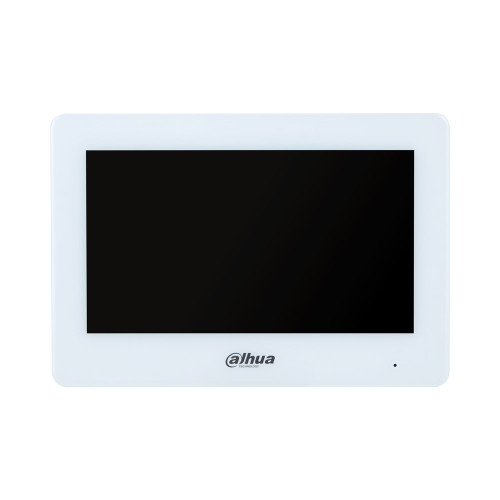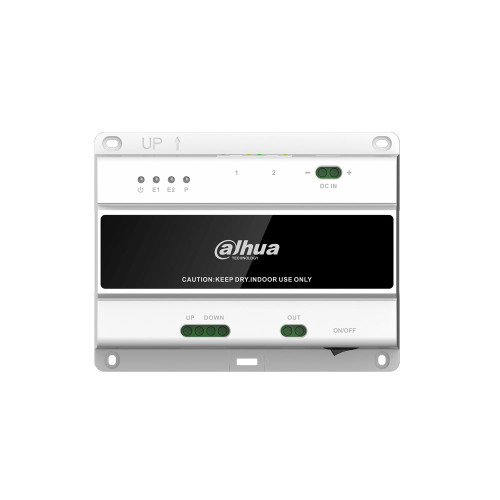

Dahua 2-Wire Intercom Controller Switch - White
The Dahua VTNS2003B-2 is a 2-wire intercom controller switch designed for Dahua IP video intercom systems using simplified two-wire cabling. It enables structured expansion of indoor monitors and door stations while also providing RJ45 Ethernet uplink connectivity for integration into IP networks.
 Key Features
- 2-wire intercom controller switch for Dahua video intercom systems.
- Supports 10-level cascading via the 2-wire port.
- Supports connection of up to 20 indoor monitors.
- Supports connection of up to 2 door stations.
- RJ45 Ethernet port for IP network integration.
- DIN rail mountable for structured cabinet installations.
 Specifications
- Item Code: VTNS2003B2A
- Model Reference: VTNS2003B-2
- System Type: Dahua 2-wire IP video intercom
- Ethernet Interface: RJ45
- Mounting: DIN rail
- Finish: White
 Dimensions

| Width | 131.1 mm |
| Height | 103.0 mm |
| Depth | 40.0 mm |
 What's In The Box
- Dahua VTNS2003B-2 2-wire intercom controller switch.
- DIN rail mounting clip.
- User documentation.
 Suitable Uses
- Multi-unit residential video intercom installations.
- Apartment and townhouse complexes using Dahua 2-wire systems.
- Retrofit installations where existing 2-core cabling is retained.
 Download PDF Resources
 Frequently Asked Questions
- Can this switch be used with standard IP intercom cabling?
No. This model is designed specifically for Dahua 2-wire intercom systems and is not intended for standard Ethernet-only intercom wiring. - How many indoor monitors can be connected?
Up to 20 indoor monitors can be connected per switch, subject to system layout and cascade design. - Is this suitable for retrofit installations?
Yes. It is commonly used in retrofit projects where existing 2-core cabling is reused.
 Additional Information
- This switch acts as a central distribution point in Dahua 2-wire intercom architectures.
- DIN rail mounting makes it suitable for structured enclosures and riser cabinets.
- Installers should observe cascade depth limits to avoid signal degradation.
.