

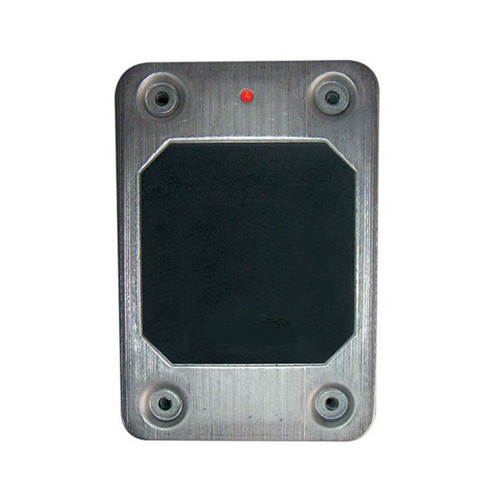
ACSS Reader CS 1-Wire Format iPR-3 Anti Vandal - Stainless Steel/Black
The ACSS ACRDVCSF (U-Prox iPR-3) is a proximity identification reader housed in a sealed polished stainless steel enclosure for use in environments where vandal resistance and durability are required. It is designed for access control systems supporting Wiegand, RS-232, and Touch Memory (1-wire) interfaces.
 Key Features
- Anti-vandal reader with sealed stainless steel housing.
- Supports Wiegand 26-bit, 37-bit, 42-bit and standard Wiegand with automatic selection.
- RS-232 serial interface and Touch Memory (1-wire) support.
- Compatible with ASK and FSK identifiers, programmable by configuration.
- Built-in buzzer and LED for audible and visual user feedback.
- Suitable for internal and external installation.
 Specifications
- Item Code: ACRDVCSF
- Product Type: Proximity access control reader
- Finish: Stainless Steel/Black
- Material: Stainless steel (1.5 mm thickness)
- Installation: Internal and external use
- Operating Temperature: -35 degrees Celsius to +65 degrees Celsius
- Supply Voltage: 9 volts DC to 16 volts DC
- Current Consumption: 50 milliamps
- Typical Read Distance: 35 mm to 40 mm (dependent on identifier type)
- Indicators: Built-in LED and buzzer
- Interfaces: RS-232, Wiegand, Touch Memory (1-wire)
- Vandal Resistant: Yes
- Dimensions: 115 mm (length) x 80 mm (width) x 15 mm (depth)
 What's In The Box
- ACSS iPR-3 proximity reader (ACRDVCSF)
 Suitable Uses
- External doors and gates where vandal resistance is required.
- Commercial and industrial access control systems in Australia.
- Sites using Wiegand, RS-232, or Touch Memory credential formats.
 Frequently Asked Questions
- Can this reader be installed outdoors?
Yes. It is weather resistant and designed for both internal and external installation.
- Which output format does the reader use?
The reader supports multiple interfaces including Wiegand and RS-232. The active output depends on configuration and controller compatibility.
- What affects the read distance?
Read distance depends on identifier type, mounting surface, and nearby metal objects.
 Additional Information
- If configured for both ASK and FSK identifiers, the reader prioritises ASK when both are presented simultaneously.
- Mounting the reader directly onto metal can reduce read range and should be considered during installation.
- Confirm controller compatibility with the required Wiegand format before commissioning.


